Latest equities, bonds, and regulatory news from United States, updated daily.
Market overview
The United States securities market is supervised by the Securities and Exchange Commission, a federal agency whose stated mission is to protect investors, maintain fair, orderly, and efficient markets, and facilitate capital formation. The Commission has up to five Commissioners appointed by the President with the advice and consent of the Senate, and no more than three of them may belong to the same political party. Below the Commission sit self-regulatory organisations that write and enforce their own rulebooks under SEC review, including the Financial Industry Regulatory Authority, the Municipal Securities Rulemaking Board and the Public Company Accounting Oversight Board, alongside the Securities Investor Protection Corporation and the Financial Accounting Standards Board.
Read the full overview and sources
The scale of what that machinery covers is set out in the SEC’s fiscal 2026 congressional budget justification. The agency reports oversight of more than 33,000 entities, among them 26 national securities exchanges, more than 3,300 broker-dealers, 109 alternative trading systems, 318 transfer agents, 6 active registered clearing agencies, more than 13,500 registered funds and more than 15,900 investment advisers. The same document puts the reporting population at more than 7,400 companies whose disclosure and financial statements the staff reviews, and describes the markets under supervision as totalling more than $100 trillion. The figures for exchanges, broker-dealers and transfer agents are stated as of FY 2024.
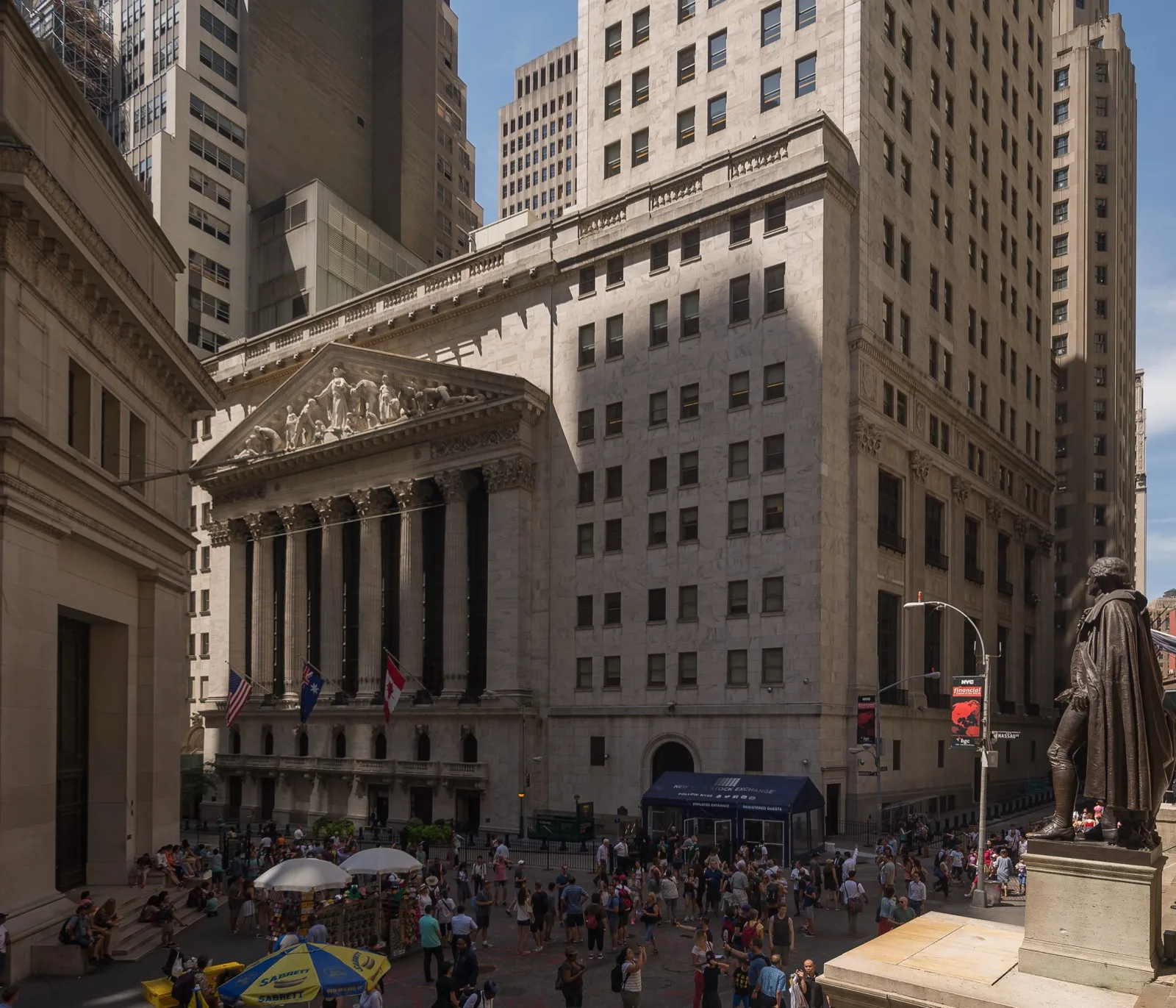
Trading is fragmented across those 26 exchanges and the alternative trading systems, but the day is organised around the primary listing venues’ auctions. The New York Stock Exchange runs an Early Trading Session from 7:00 a.m. to 9:30 a.m. Eastern time, a Core Trading Session from 9:30 a.m. to 4:00 p.m. opened by the Core Open Auction, a Closing Imbalance Period from 3:50 p.m., a Closing Auction at 4:00 p.m., and a Late Trading Session to 8:00 p.m. Settlement is one business day after the trade. The Commission adopted the shortening from T+2 to T+1 on Feb. 15, 2023, with a compliance date of May 28, 2024, and paired it with same-day allocation, confirmation and affirmation requirements and straight-through processing obligations on central matching services.
Equities share the market with the largest government bond programme in the world. Treasury’s Debt to the Penny series put total public debt outstanding at $40,112,464,593,206.30 on 2026-09-01, of which $32,420,529,452,197.11 was held by the public. The Office of Debt Management reported total receipts of $4,151 billion and total outlays of $5,518 billion through Q3 FY2026, projected privately-held net marketable borrowing of $739 billion for Q4 FY2026 against an assumed end-of-quarter cash balance of $950 billion, and noted that all primary dealers expected no changes to nominal coupon, TIPS or floating rate note issuance sizes at the August refunding.
Index construction is a private, published discipline rather than a state function. The Nasdaq-100 Index measures 100 of the largest Nasdaq-listed non-financial companies on a modified market capitalisation weighting, restricts membership to companies primarily listed on a U.S. Nasdaq-affiliated exchange, excludes anything classified in the Financial Industry under the Industry Classification Benchmark, and rules out real estate investment trusts, special purpose acquisition companies and when-issued securities. GSN covers this market through company filings and exchange announcements, Commission rulemaking and enforcement, and Treasury issuance.
Sources
This overview is based on the official documents listed below, last checked 2026-09-03. Figures are as stated in those documents.
About the SEC · U.S. Securities and Exchange Commission · 2026-09-03
Comtech is selling most of its satellite and space business to an affiliate of Gilat Satellite Networks. Its new finance chief has satellite experience, which says something about how carefully the exit is being handled.
Arrive AI Inc. (NASDAQ: ARAI) is launching a dedicated defense division to adapt its autonomous delivery infrastructure for military use. The company says the move could open non-dilutive government funding, but it has disclosed no contracts.
A test-equipment maker is buying into a probe and interface specialist to speed AI-era chips to production. The deal opens several futures, and the announcement settles none of them.
A Phase 3 trial of firmonertinib in an EGFR exon 20 lung cancer failed on its main independent measure while looking better on others. ArriVent now has to decide what that split result is worth.
Editas Medicine has cleared the hurdle to start dosing people with EDIT-401, a one-time gene edit meant to lower LDL cholesterol. The primate data are striking; the human question is entirely open.
Safe Pro Group has given preliminary, unaudited third-quarter revenue far above last year, which it credits to U.S. defense subcontracts. The final close, and what comes after it, will show how much of that is repeatable.
A Denver-based AI investor points to 124 unmanned French fuel stations as proof for its portfolio company Manako Labs. The release does not say that any of that French money reaches TaoWeave.
Rank One Computing has added biometrics scientist Dr. Anil Jain to its board, alongside an existing advisory role. GSN asks whether deep scientific expertise on the board can turn into commercial traction for its Vision AI platform.
Wolfspeed (NYSE: WOLF) has received a conditional commitment for up to $1.5 billion in financing from the U.S. Department of War. This report examines whether the capital would stabilize the silicon carbide maker or bind it to a rigid national security agenda.
The first quarter with Kloeckner inside made Worthington Steel far larger and loss-making on the bottom line. The real prize, operating control through a domination agreement, is still waiting on approvals.
By closing its purchase of Israeli retail media firm Hedia, A2Z Cust2Mate has bought advertiser relationships and campaign execution capabilities. The open question is whether an acquired sales team can sell A2Z's own in-store media inventory.
Blaize revised its full-year revenue range to far above its latest quarter, resting it on signed orders, inventory, suppliers and timely payment, days after announcing cuts to about a quarter of its staff.
CTO Realty Growth (NYSE: CTO) paid $103 million for a nearly full open-air power center near Kansas City, lifting its 2026 investment total to $439 million. GSN asks how long that pace can last and how the deal was paid for.
QCi's new investor deck leads with a debt-free cash pile. The open question is how much business that money is buying, and how soon customers start paying their share.
ACM Research says its Shanghai subsidiary's order backlog grew sharply from a year earlier. The release's own caveats explain what that figure does and does not promise.
A binding 50 MW deal with Nebius gives AIB Data Centers a customer and a financing plan that leans on customer prepayments and project financing rather than shareholders. Whether the building gets finished, and what comes after it, is still open.
Astro Digital plans to go public by merging with Proem Acquisition Corp I (Nasdaq: PAAC). GSN asks whether its claims of growth and positive adjusted EBITDA can support a roughly $587 million valuation.
A Florida magnet maker and a Florida hydrogen company have put their ambitions in writing. The fine print says the writing mostly binds them on confidentiality, publicity and expenses.
Nauticus Robotics (Nasdaq: KITT) has secured a temporary reprieve from a triggering event on its convertible preferred stock, but the underlying debt restructuring continues to reshape the company's capital structure.
A California sales tax exclusion for a planned silicon wafer plant is real, but it is a discount on purchases not yet made, and the release says almost nothing about how those purchases will be paid for.
An FDA Fast Track designation and the sale of a majority stake in its Chinese subsidiary narrow BeyondSpring's story to one question: can its lung cancer trial reach its interim readout?
Kraig Biocraft Laboratories (OTCQB: KBLB) has shipped a small first commercial order of recombinant spider silk yarn to an unnamed performance sports brand. GSN asks whether a precision pilot order says anything about the company's ability to scale.
Immix says its CAR-T therapy has produced complete responses in 40 of 45 AL amyloidosis patients. The headline's higher figure depends on four patients who have not yet reached complete response.
A New Haven biotech says its antibody caused markedly fewer side effects than an mRNA COVID vaccine in a Phase 3 study. Whether it becomes a real alternative now rests on a second study and on how the FDA reads antibody levels.
A drone executive is leading a small personal investment into Brightline as it fights to keep its Nasdaq listing. The upfront cash matters less than the warrants attached, which pay out only if the shares recover.
Cipher Digital has pushed contracted revenue at its Texas data center past $9 billion by adding a second decade with an unnamed AI lab. The price is a cost-overrun framework that leaves Cipher carrying the first slice of any budget miss.
A new study says the Santa Cruz copper project works even at a conservative copper price. Most of the headline value, though, rests on today's price, and the study excerpt reviewed does not say who funds the build.
Veracyte (Nasdaq: VCYT) has eight studies on its Decipher prostate cancer test at ASTRO 2026, but no findings have been disclosed yet. GSN asks whether the data will show the genomic classifier can help guide treatment decisions.
A Shell feasibility study named Rhode Island sites as suitable. No agreement, site, capacity, cost, buyer or permit is disclosed. How to read a pre-project announcement.
PPL Electric Utilities has been selected for up to $71.5 million to rebuild a 29-mile line with higher-capacity conductors and listening fibre. The award terms are still to be negotiated.
About six times this year's expected revenue and two-thirds of Cognex's cash, plus $106 million to keep the team. The facial-authentication line is spun out first, and the release gives no profit figure.
Three INDIGO presentations cover open-label durability, steroid toxicity and vaccine responses. The abstract titles state conclusions; the numbers are not yet public, and no filing date is given.
D-Wave furnished an 8-K announcing a user conference in Seoul on October 28, 2026. The filing names presenters from NTT DOCOMO, LG CNS and three universities but gives no revenue, customer count or contract value for any of them.
CUE-221 beat placebo at all three doses in a 145-patient Phase 2 trial in China. The comparison with omalizumab was not statistically tested by design, the arm sizes in the tables sum to 143, and the release gives no cash or cost figure for the next study.
GCT Semiconductor raised its chief financial officer's salary from $304,500 to $330,383 and set a half-year bonus plan at 25 percent of base salary. The filings give no revenue target, no weighting and no salaries for the other three officers.
NextEra and Dominion propose four years of $10 monthly credits, 600 NextEra jobs and 400 supplier jobs in Virginia. The filing gives the old $1.78 billion credit total but not the new one, and does not say how much is new money rather than redirected.
The company received FDA confirmation on the pivotal Phase 2 trial framework for RP-A501, clarifying the path to potential accelerated approval for Danon disease.
Artificial Intelligence Technology Solutions Inc. announced its robotic security devices are now integrated with the Immix professional monitoring software platform.
Georgia Power (NYSE: SO) received regulatory approval for 1,137 MW of new solar power purchase agreements, marking the largest single solar procurement in the company's history.
York Space Systems will serve as prime contractor for the initial phase of Tomorrow.io's DeepSky early warning constellation, delivering satellites on its M-CLASS platform.
Milestone Pharmaceuticals (Nasdaq: MIST) announced China's regulatory approval of etripamil nasal spray for heart rhythm disorder, marking the first approval of the drug outside the United States.
Monte Rosa Therapeutics announced a $50 million milestone payment from Novartis following the initiation of a Phase 2 clinical study for its Sjogren's disease treatment candidate.
Roivant Sciences will present topline results from its Phase 2 PHocus study of mosliciguat in patients with pulmonary hypertension associated with interstitial lung disease at the ERS Congress 2026.
ACI Worldwide has agreed to acquire Cranium Ventures and its SYNAP card switching framework for ACI Connetic. Terms were not disclosed and the deal is expected to close by the end of September.
Aficamten met both primary endpoints in the first Phase 3 trial to succeed in non-obstructive hypertrophic cardiomyopathy, and Cytokinetics plans a supplemental FDA filing in the fourth quarter.
Bleichroeder Acquisition Corp. II shareholders approved the Pasqal business combination on August 25, 2026 and the deal closed two days later. Holders of 26,039,602 of 28,750,000 public shares redeemed.
The first of two pivotal wet AMD trials failed its primary visual acuity endpoint in the full dataset; EyePoint points to secondary endpoints and an ad hoc analysis excluding nine patients.
Newbury Street II Acquisition Corp announced a definitive business combination agreement with FORT Robotics to create a publicly traded entity focused on physical AI safety.
Fernando Queiroz, CEO of Levona Renewables, writes that transmission and interconnection work now consume more of his team's time than solar equipment does on a recent ERCOT-zone project.
In a shareholder letter filed with the SEC, Nexscient said its April acquisition of Flipside AI turned it into an operating business and outlined new AI data clients and Nasdaq uplisting plans.
Parsons, an engineering and construction services firm, has been selected to provide project management and construction management services for a major airport terminal renovation in Knoxville.
Rocket Lab filed pro forma and historical financial statements tied to its pending acquisition of satellite operator Iridium Communications, detailing deal terms and a $3.6 billion bridge loan.
Serve Robotics, a San Carlos-based autonomous delivery company, disclosed a Grubhub partnership, two new markets, and a next-generation hospital robot in an August 17 SEC filing.
Babcock & Wilcox will supply 20 Siemens Energy steam turbine generator sets totaling 1 gigawatt of capacity for its FastPower data center program, the company said.
Comstock's second-quarter filing sets out the cost, permitting status and rated capacity of the Silver Springs solar panel recycling plant, and the mining sale that funds it.
An amended SEC filing that corrects a slide in the company's investor presentation discloses second-quarter revenue growth, design wins, and third-quarter guidance.
Ondas Inc. said it has closed its previously announced acquisition of drone inspection firm Cyberhawk, expanding into critical infrastructure intelligence.
The connected-fleet software company reported first-quarter results, updated fiscal 2027 guidance, and named a new president and CFO plus a chief AI officer.
Rocket Lab reported record second-quarter 2026 revenue of $234 million and a record $2.36 billion backlog, and guided to another record revenue quarter in Q3.
The Seattle-based cell therapy company posted second-quarter 2026 financial results alongside clinical progress on its diabetes and lymphoma programs and a new Mayo Clinic collaboration.
Ichor Holdings posted second-quarter 2026 revenue of $294.8 million, up 15% sequentially, swung to GAAP profitability, and guided to further growth for the third quarter.
Shentel posted 5.5% revenue growth in the second quarter of 2026 as its Glo Fiber expansion segment grew 32.8% and the company reiterated full-year guidance.
Momentus told investors its Vigoride 8 mission is fully booked with two NASA payloads for 2027. The same filing shows $107.6 million of cash after $109.9 million of net financing in the first half.
Nauticus Robotics said it completed the first prototype of a compact electric subsea manipulator. Its second-quarter filing confirms the build and shows service revenue down 57% year on year.
Microbot Medical says LIBERTY robotic system drove more than 100% quarter-over-quarter growth in revenue and customers in Q2 2026, alongside new hospital adoptions, a federal supply agreement, and its first clearance outside the US.
NewHydrogen, Inc. said it is automating its Engineering Test Unit to support development of its ThermoLoop hydrogen technology, aiming for round-the-clock testing ahead of a planned pilot plant.
How SEC Regulation NMS forces brokers and exchanges to route orders to the best displayed price, and what actually counts as a trade-through violation.
Behind every tender offer headline is a specific number: the premium over the recent trading price. Here is the mechanics of how that figure gets built.
A single ticker can stop trading for hours while the rest of the market carries on as usual, and understanding why reveals two very different regulatory tools at work.
A single comment letter rarely moves a regulator. Here is the quiet, multi-year process that actually determines when a securities watchdog reopens an existing disclosure rule.
 lobal Securities News