lobal Securities News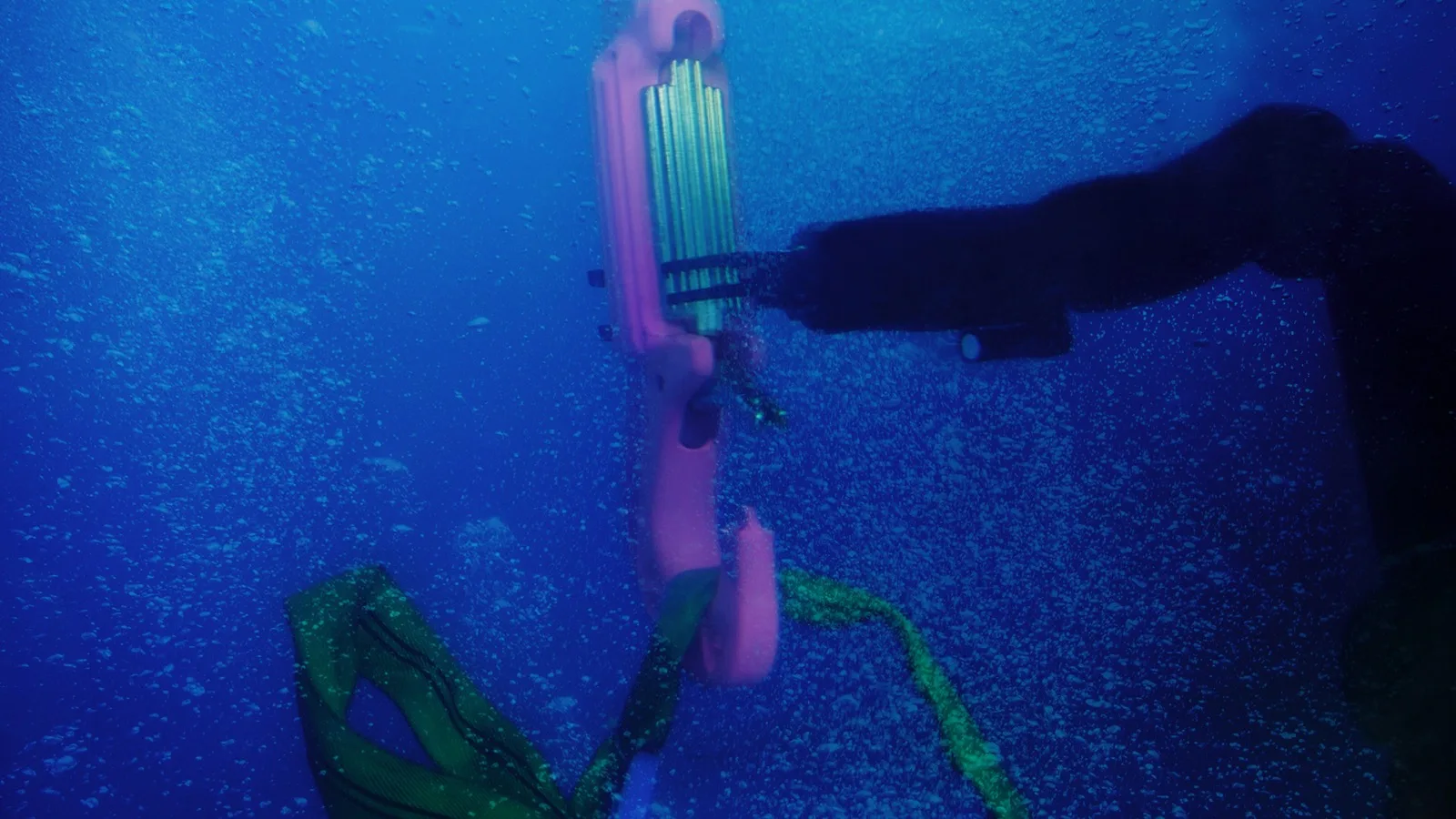
Analysis: a component milestone reported against a shrinking revenue base
The prototype build is recorded in a filed document as well as in the announcement. What it is not is evidence of demand. The filing describes interest and evaluation, not orders. The manipulator generated no revenue in the quarter and the only revenue the company did earn, from ROV services, more than halved.
The strategic logic is legible. Nauticus already sells the Olympic Arm into the work-class market through Forum Energy Technologies, and that route gives it a manufacturing and sales partner it does not have to build. A smaller, cheaper arm aimed at observation-class ROVs and AUVs widens the addressable base without a second partner, and it is the piece that makes Aquanaut a complete intervention system rather than an inspection platform. That is consistent with the company’s statement that defence interest in the manipulator is pulling through to Aquanaut discussions.
The financing sequence is the part a press release does not show. A $1,500,000 note issued on July 20, 2026 that matures on September 9, 2026 is working capital measured in weeks, not a development budget. With $1,977,048 of cash at the end of June and a half-year operating loss of $11,692,410, the company is converting debt into preferred stock and issuing fresh short-dated paper at the same time. The June exchange removed roughly $4.0 million of debt at the cost of a $4,629,822 non-cash extinguishment charge and a preferred instrument that can be repeated at the holder’s option.
A reader following this story from documents rather than announcements would watch for three markers: whether third-quarter service revenue recovers from the reported slow start, whether the next-generation manipulator moves from prototype to a named order or a partner agreement of the kind the Olympic Arm has, and how much of the term loan balance the holder converts into further Series C preferred stock, since that determines dilution independently of anything happening in the water.
What the documents say
Nauticus Robotics, Inc. (Nasdaq: KITT) announced on July 28, 2026 that it had completed the first prototype of a next-generation electric manipulator, the arm it intends to sell into smaller observation work-class remotely operated vehicles and autonomous underwater vehicles. The company’s quarterly report for the period ended June 30, 2026 records the same event in one sentence: “The initial design of the fit-for-purpose electric manipulator was completed in the first quarter of 2026, and the team completed the first prototype build.”
That is the whole of the verified technical disclosure. No test result, delivery date, order, or customer accompanied the announcement. The filing that describes the prototype also describes a company whose revenue fell by more than half in the quarter and which was funding itself, eight days before the announcement, with a new short-dated convertible note.
The product and where it sits in the portfolio
Nauticus, based in Webster, Texas, builds autonomous underwater vehicles, remotely operated vehicles, electric robotic manipulators and the Nauticus ToolKITT software platform. Its flagship vehicle is Aquanaut, which the company says performs subsea tasks with integrated electric manipulation and minimal surface support. Its existing arm is the Olympic Arm, a fully electric subsea manipulator whose patented electric actuators replace hydraulic systems, designed for work-class ROVs and for Aquanaut.
The next-generation manipulator is a different product from the Olympic Arm. The company describes it as addressing known use cases that require a less complex solution, and says demand from the smaller observation work-class ROV and AUV markets for a compact, fully electric manipulator remains strong. The Olympic Arm programme is being matured under a joint manufacturing and sales agreement with Forum Energy Technologies signed in the fourth quarter of 2025, with testing continuing at the Houston facility and preparation for broader testing by Forum.
On the vehicle side, the company reported that Aquanaut Vehicle 1 has completed over 500 hours of in-water testing on client-driven workflows and has performed over 200 successful vertical inspection behaviours on mooring lines, work carried out in Florida. Vehicle 2 remained in Florida preparing for offshore deployment. Nauticus says interest in the manipulator has fed into broader discussions about Aquanaut, with recent engagement driven primarily by the defence sector evaluating an Aquanaut vehicle paired with an electric manipulation system.
What the second-quarter numbers show
Service revenue, the company’s only revenue line, was $885,947 for the three months to June 30, 2026, down $1,189,619 or 57% from $2,075,566 a year earlier. For the six months it was $1,045,521 against $2,240,822, a fall of $1,195,301 or 53%. The company attributes the decline to a slow start to the year in the ROV market.
Costs came down but not by as much. Cost of revenue for the quarter fell 18% to $2,867,556, while general and administrative expense fell $1,093,822 or 25% to $3,324,365, which the company credits to the absence of non-recurring costs from the SeaTrepid acquisition completed at the end of the first quarter of 2025 and to cost savings started at the end of 2025. Depreciation and amortisation rose 22% to $702,418. Operating loss for the quarter was $6,008,393 against $6,421,227.
Below the operating line the picture is heavier. A loss on extinguishment of debt of $4,629,822 in the quarter, and $5,559,330 for the half, arose mainly from exchanging November 2024 debentures and convertible senior secured term loan notes for Series C preferred stock. Interest expense fell $382,341 or 32% as balances converted. Net loss was $11,115,971 for the quarter, against $7,454,176 a year earlier, and $20,382,051 for the six months against $15,021,363.
The company held $1,977,048 of cash, cash equivalents and restricted cash at June 30, 2026. Financing brought in net proceeds of $8,548,929 in the half from the November 2024 debentures and an at-the-market share offering, against $19,438,121 raised through equity a year earlier. Management states that substantial doubt exists about the company’s ability to continue as a going concern for at least twelve months from the date the June 30, 2026 statements were issued.
The financing that framed the announcement
Two debt events sit either side of the manipulator news. On June 26, 2026 an institutional holder exchanged approximately $4.0 million of outstanding convertible term loan securities, including accrued interest, for 4,800 shares of Series C convertible preferred stock with an aggregate stated value of approximately $4.8 million, under Section 3(a)(9) of the Securities Act. The same holder retains the right to require further exchanges of remaining term loan indebtedness into more Series C stock.
Then, on July 20, 2026, the company issued an original issue discount senior secured convertible debenture with an aggregate principal amount of $1,500,000, convertible into 197,369 shares of common stock at a conversion price of $7.60, to an institutional investor under the November 2024 securities purchase agreement. The note matures on September 9, 2026 unless repaid earlier.