lobal Securities News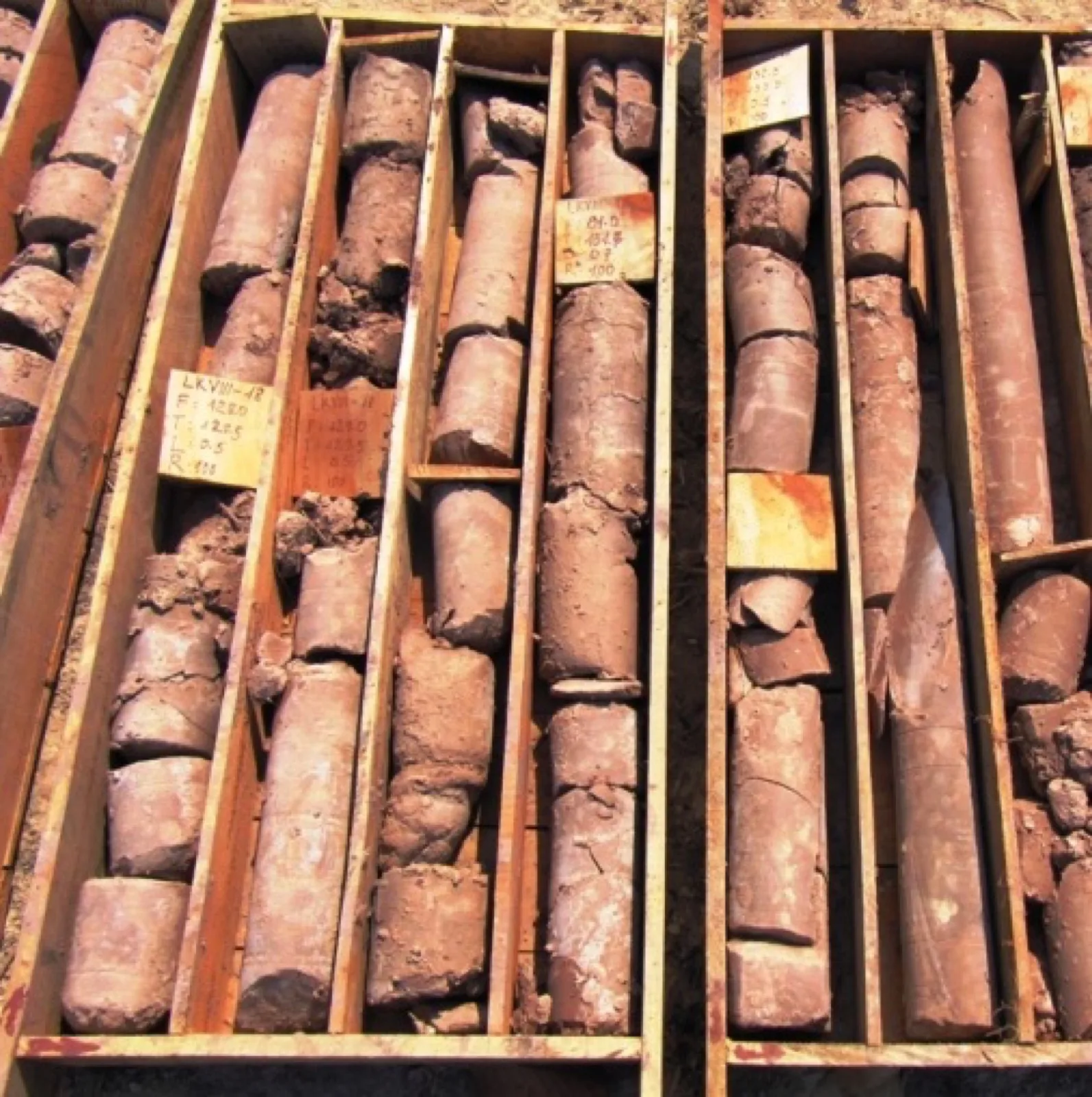
Analysis: read the true thickness column, not the headline
The release contains two width numbers for every hole and they are not interchangeable. The 119.1 metres quoted for R-0051 is a downhole length. The company’s own drilling summary table gives the same hole a true thickness of 83.0 metres, and puts the true thickness of the 31.9 metre high-grade section at 20.8 metres. The pattern repeats across the batch: R-0050’s 146.1 metres of downhole oxide corresponds to 103.3 metres true, R-0052’s 160.6 metres to 134.7 metres, R-0053’s 202.3 metres to 132.1 metres, and R-0054’s 120.5 metres to 97.7 metres. Because the holes were drilled at different dips, from minus 45 to minus 70 degrees, the ratio between the two measures varies hole to hole. Comparing headline intercepts across holes without that column will systematically overstate how much rock is actually there, and it will overstate it unevenly.
The second thing the disclosure does not establish is economics. Grade in a titanomagnetite deposit is only half the question; the other half is whether the titanium and vanadium can be separated into saleable products at acceptable recoveries and costs. SAGA says petrographic work indicates the titanomagnetite mineralisation favours simplified processing and that metallurgical test work is under way, but the release carries no recovery figures, no concentrate specification and no cost estimate. Nor is there a mineral resource estimate yet. Assay intercepts are inputs to one, not a substitute for it.
Price context matters here because the deposit carries three products. The US Geological Survey put the average 2024 price of vanadium pentoxide at $5.45 per pound, down from $7.50 in 2023 and $9.29 in 2022, so the vanadium credit in any future model is being struck against a falling series rather than a rising one. On the titanium side, the USGS reports that more than 95% of titanium mineral concentrates are consumed by pigment producers, with bulk ilmenite from Australia at about $500 per metric ton in 2024, roughly a third of the $1,310 per metric ton for bulk rutile. An iron-titanium-vanadium concentrate is not a pigment feed without further processing, which is why the metallurgical work rather than the next batch of assays is the more consequential item on SAGA’s schedule.
There is a policy tailwind that is real but easily overstated. The USGS lists Canada as the source of 48% of US ferrovanadium imports and 34% of total vanadium imports over 2020 to 2023, and Canada supplied 13% of US titanium mineral concentrate imports over the same window. That makes a Canadian deposit strategically legible. It does not make an undeveloped Labrador oxide body competitive with an operating mine, and nothing in the July release speaks to capital cost or timing.
What the documents say
SAGA Metals Corp. (TSXV: SAGA) reported assay results on July 22, 2026 from five diamond drill holes at the Trapper Zone of its wholly owned Radar Titanium-Vanadium-Iron project near Cartwright, Labrador. The headline number was hole R-0051, which returned 119.1 metres grading 42.68% Fe2O3, 5.89% TiO2 and 0.280% V2O5, including 31.9 metres at 53.07% Fe2O3, 7.68% TiO2 and 0.384% V2O5. The Vancouver company, which also trades on the OTCQB under SAGMF and in Frankfurt under 20H, is drilling toward a maiden mineral resource estimate.
What the five holes returned
The release covered holes R-0050 through R-0054, all part of a resource drill programme started in the fourth quarter of 2025. R-0050 cut 128.1 metres at 40.80% Fe2O3, 5.79% TiO2 and 0.294% V2O5, with a 53.0 metre section at 49.61% Fe2O3, 7.24% TiO2 and 0.401% V2O5. R-0052 returned 112.4 metres at 46.67% Fe2O3, 6.71% TiO2 and 0.305% V2O5, including 66.0 metres at 49.63% Fe2O3. The longest interval came from R-0053 at 159.9 metres grading 45.27% Fe2O3, 6.32% TiO2 and 0.306% V2O5, with sub-intervals of 37.5 metres and 62.0 metres. R-0054 was the shortest of the five at 57.8 metres grading 44.92% Fe2O3, 6.71% TiO2 and 0.275% V2O5.
The company also published hole-by-hole logging detail. R-0051 was collared on pad AO-1 at an azimuth of 38 degrees and a dip of minus 60 degrees, reached a total depth of 311 metres, and entered the oxide zone at 99.9 metres. That zone measured 127.4 metres downhole, made up of 38.5 metres of semi-massive oxide and 88.8 metres of rhythmic layering. R-0053 was the deepest oxide intersection of the group, logging 202.3 metres of oxide within a 299 metre hole.
Where the programme stands
SAGA said results have now been received for forty-seven diamond drill holes, out of sixty-seven completed between the fourth quarter of 2025 and the date of the release, numbered R-0008 to R-0074. Holes R-0075 and R-0076 were being drilled. Drilling in the Trapper Zone totalled 17,448 metres, split between 2,050 metres in 2025 and 15,398 metres in 2026, with 9,674 core samples collected. Core recovery was reported above 95%.
The sample pipeline is the constraint on news flow. SAGA said 475 samples from holes R-0055, R-0056 and R-0057 had reached IGS Laboratories, with results expected shortly, and that a further 612 samples from R-0058, R-0059 and R-0060 had been shipped. Assays remain pending for a run of holes including R-0061, which the company describes as its widest oxide intersection to date at 244.4 metres downhole and a true thickness of 204.7 metres.
The Trapper Zone sits inside what SAGA calls a 29 square kilometre central oxide corridor that also contains the Falcon and Hawkeye zones. The company said mineralisation has been confirmed in 74 out of 74 holes drilled, that grades have reached 72.33% Fe2O3, 13.3% TiO2 and 0.66% V2O5 in semi-massive to massive oxide, and that the property has road access, a deep-water port, nearby hydro-electric power and a regional airport. Michael Garagan, chief geological officer and a director, said the holes “continue to deliver outstanding thickness and grade continuity at Trapper South”.
What to watch next
The maiden mineral resource estimate is the document that converts this drilling into a number the market can price, and the assays still outstanding for roughly twenty holes will feed into it. Between now and then, the disclosures worth reading closely are the metallurgical results, the true thickness column in each new table, and whether the grade consistency seen at Trapper South holds across the Falcon and Hawkeye zones, which have not been drilled at the same density. Newfoundland and Labrador has published provincial exploration statistics since 1981, and the drilling and expenditure series there provides the backdrop against which a programme of this size can be judged.