Editor’s note: This is an educational explainer about how U.S. market infrastructure works. It is general information, not investment advice, and does not describe any specific current event, company, or security.
There is a number that almost no one outside a trading desk thinks about, and it moves every few seconds during market hours. It’s a running comparison between where the S&P 500 sits right now and where it closed the day before. Most of the time it drifts within a band nobody notices. But cross a threshold — down 7%, then 13%, then 20% — and something happens that most retail investors have never actually watched unfold.
The Three Thresholds
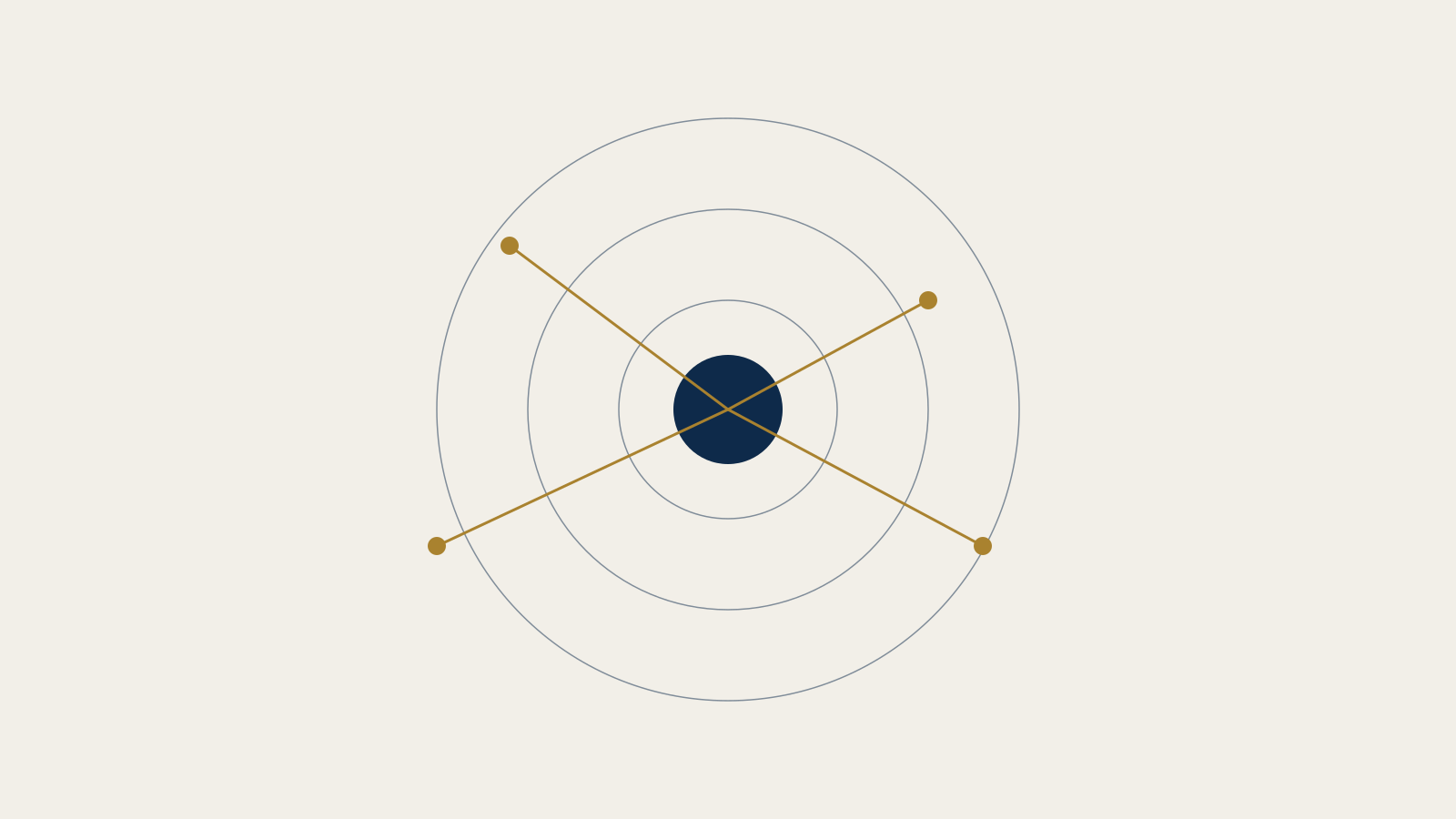
U.S. equity markets operate under a system of “market-wide circuit breakers,” administered jointly by the exchanges under rules approved by the Securities and Exchange Commission. They’re triggered off the S&P 500’s decline from the prior session’s closing price, measured continuously throughout the trading day.
A 7% decline (a “Level 1” breach) pauses trading across all U.S. exchanges for 15 minutes — but only if it happens before 3:25 p.m. Eastern. A 13% decline (Level 2) triggers the same 15-minute pause, again with that same late-afternoon exception. A 20% decline (Level 3) is different: it halts trading for the remainder of the session, no matter what time it happens.
That 3:25 p.m. cutoff is easy to miss and worth sitting with for a moment. It exists because regulators decided that halting trading too close to the closing bell could do more harm than good — it can strand orders, distort the final print, and create exactly the kind of illiquid, chaotic close the rule was designed to prevent in the first place.
Why the Threshold Isn’t Arbitrary
The current three-tier structure dates to a 2012 SEC rule overhaul, itself a response to lessons learned from the 2010 “Flash Crash,” when the Dow Jones Industrial Average dropped roughly 9% and recovered within minutes — too fast for any human, or for the circuit-breaker rules that existed at the time, to meaningfully intervene. The redesign shifted the trigger from the Dow to the broader S&P 500, and rebuilt the percentage bands around the idea that a pause should be long enough to let information catch up with price, but short enough not to trap capital that legitimately needs to move.
That tension — between protecting a market from its own velocity and preventing regulation from becoming the obstacle — sits underneath a lot of market-structure rulemaking, not just circuit breakers. Individual stocks have their own, narrower version of this same idea: the Limit Up-Limit Down mechanism, which pauses trading in a single security if its price moves outside a percentage band relative to recent trades, without freezing the entire market around it.
What a Halt Doesn’t Do
It’s worth being precise about what a circuit breaker halt actually accomplishes, because it’s easy to overstate. A halt does not reverse a price move, does not protect any individual investor’s position, and does not signal that a decline is over. It buys time — nothing more, nothing less. What happens with that time is determined by everything outside the mechanism itself: incoming information, order flow, and the judgment of everyone still willing to transact when trading resumes.
The last time a Level 1 breaker triggered was March 2020, during the onset of pandemic-driven volatility — a reminder that these mechanisms sit dormant for years at a stretch, built for a scenario most market participants will only ever read about rather than live through. Whether that’s a sign the system is working, or simply that it hasn’t yet been tested by something the 2012 redesign didn’t anticipate, is a question market-structure regulators continue to revisit.